Monday, September 6, 2010

If I end up a spinster, I'll still have brown cheese.


Brown cheese you ask?

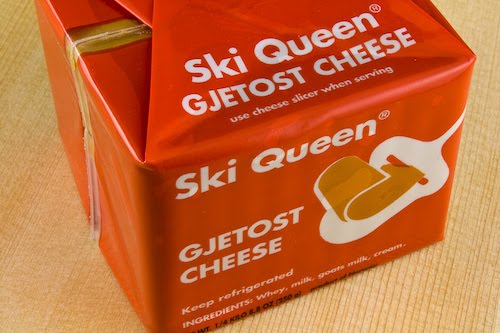
Brown cheese is a Norwegian institution, and is known locally as brunost. A Norwegian who doesn't eat brunost is like an Australian who doesn't eat vegemite. According to the BBC, annual production of brunost is equal to 4kg per Norwegain. Here at Folkehøyskole we have the opportunity to eat it 3 times a day; breakfast, lunch and supper. Infact it tastes nothing like cheese at all, you'll find out why soon. It is characterised as a sweet, strong cheese with caramel and goat cheese flavours. Funny that, considering it is made mostly from goats milk. Depending on the variety, brunost can have a very sharp pronounced flavour, even leaving a stinging sensation in the mouth. The varieties with higher cow milk contents are less sharp and more caramel like in flavour. Original Brunost is made with goat whey only, it's darker colour indicating a sharp, pronounced flavour.
When driving along Norwegian country highways it is common to see vans selling "100% Ekte Geitost", this translates to "100% Real Goat cheese". Those van people think they are being clever selling a product made 100% from goats milk, but technically it isn't cheese. So they are only 50% correct, yes it's from a goat, no it's not really cheese. It is actually made from whey. Whey is what is leftover after milk has been curdled and strained.
Brunost is made by boiling a mixture of milk, cream and whey carefully for several hours so that the water evaporates. The main use of Brunost is on sandwiches, like open-faced sandwiches or Norwegain waffles. It is usually eaten as the sole sandwhich topping, but can also be eaten with berry jams. Note: brown cheese must NOT be eaten with ham or tomatoes or smoked salmon or anything else savoury, the Norwegians will look at you like as if you are a lunatic. Leftover brun ost is made into different kinds of foodstuffs. Many strange concoctions existed and some of these are still available. Brun ost is used to make gravy for game meats and is served with juniper berries (the berries used to make gin). It can also be used to make a sandwhich spread known as prim. With a water content above 30%, making it spreadable, Prim is almost a Brunost cousin. One of the cooks here at folkehøyskole made the best prim EVER last week. She melted down the brun ost and added milk, golden syrup, vanilla, sugar and corn flour to thicken. DELICIOUS. I think prim would also taste amazing with cinnamon or cardamom mixed in. Australia and many other countries outside of Norway, brun ost is sold under the name "Ski Queen". Look for it at IGA or the cheese section at your local supermarket. It's expensive, but worth it.

Monday, August 30, 2010

Tante Åses Rhubabra Pai med Vanije Saus.

Pastry
175g butter
250g flour
2 tbs cold water
1 egg yolk
2 tbs sugar
Mix pastry ingredients until "right consistency" add extra flour or water if needed.
Chill in the fridge for at least 1 hour.
Rhubarb Pie Filling
1/2 kg rhubarb
3/4 cup sugar
2 tbs icing sugar
1 tsp cardamom
1 tsp cinnamon
1 tsp corn flour
Stand for a couple of hours to draw out the flavours. Then add some corn flour to thicken the rhubarb mixture. If the rhubarb filling is too sloppy then the pie will be no fun to eat.
Vanilla Cream
200 ml milk
2 tbs sugar
2 egg yolks
2 tbs corn flour
1 tbs vanilla sugar
Bring milk and sugar to the boil.
Mix vanilla sugar, egg yolk, corn flour.
Mix vanilla mixture into milk mixture.
Bring to boil and then simmer until thickens. It thickens quite fast.
To assemble pie:
Roll dough, and place into pie dish.
Layer the vanilla sauce and the rhubarb.
Add some chopped almonds to the top.
My aunt decided at to also add a layer of meringue on top of the pie. To do this whisk the left egg whites and some caster sugar until soft peaks form. Then spread on top.
Bake in the oven at 180 degrees for 45 minutes.

Tuesday, August 24, 2010

Folkehøgskole.

This year I am spending a year studying Norwegain language and culture at a Folkehøgskole. It is located in Søgne a small town on the southern coast of Norway.
So I guess most people will wonder what Folkehøgskole is.
Basically people go there when they have finished high school and are not sure what to do with them selves. You choose a main subject to study over the course of the year. At my Folkehøgskole they have art, photography, outdoor education, rhythmic jazz, tourism and a Norwegian course for international students. I am doing the Norwegian course. Then you also choose some other classes to take once a week, for example Spanish, Russian, line dance, salsa, barista training ect. This year they don't have a Spanish teacher so two of the other international students and I are taking the class. Can't wait! We plan to teach language, culture and do some Spanish cooking.
Folkehøgskole is kind of like being in Big Brother. You watch as people who have never met before interact. You watch them become friends, become couples, become enemies. It is also a bit like being at boarding school because you live in dorms of 2 people, eat all your meals together and have classes together. And it's unlike boarding school because there are no grades, and you have a lot of freedom. All the students are over 18, so the teachers don't have to take responsibility for out safety.
We eat SO much food at Folkehøgskole! Breakfast at 8am, lunch at 11.30am, dinner at 2.45pm and supper at 8pm. Then there is the coffee problem. I am going to return to Australia a complete caffeine addict. There is always a pot of freshly brewed coffee sitting on the counter, so I end up drinking about 6 cups a day. INSANE.
Students are not allowed to drink alcohol or store alcohol on school premises. So on Saturday everyone went to the supermarket, bought beer and hid it in the forrest. Then after dinner, we collected our beers from behind the trees and walked for about 20 minutes through the forrest to a girl guide hut. Thirty of us dragged all the wooden benches together, into a massive line and sat by the lake drinking our beer. Pretty fun and very random.
I'll keep you updated. With 107 students living together there is bound to be some interesting stories to tell.

Friday, August 20, 2010

Grandma's Buttermilk Waffles.

There is nothing like fresh fluffy waffles for afternoon tea. Especially when your grandmother makes them for you, and serves them with her homemade strawberry jam. In fact my grandmother even grew the strawberries to make the jam. Pretty impressive for an 89 year old. Unlike Belgian waffles, these waffles are not crispy on the outside. Instead the whole waffle is fluffy due to the buttermilk.
2 1/4 cups plain flour 1 tsp. baking powder1 tsp. salt 1 tsp. baking soda 2 eggs, beaten 2 c. buttermilk 8 Tbsp. butter, melted 1/4 tsp. cardamom powder
Strawberry jam and cottage cheese to serve.

Whisk together flour, baking powder, salt and baking soda. Add eggs, buttermilk, spices and butter. Stir together well.If batter seems too thick, add a tablespoon or two of buttermilk; if batter seems too thin, add a tablespoon or two of extra flour. Stir to mix.

Wednesday, August 18, 2010

Still not sure what a fjord is?

20 Interesting Facts About Norway.

  1. Norway is not the capital of Sweden.
  2. It is against the law to buy alcohol on Sunday.
  3. There are no stop signs. You just have to look both ways at every intersection.
  4. Nobody goes out for breakfast. And even if they did, there would be no pancakes with bacon and maple syrup, or eggs hollandaise or big breakfasts. :(
  5. It is acceptable to eat lunch at 11am and dinner at 3pm.
  6. It is acceptable to eat soft serve for lunch. It is also acceptable for the young icecream shop attendant to have a competition with their colleagues to see who can put the most soft serve in a standard cone. The consumer of the soft serve will then have a heart attack or a panic attack from the sheer volume of lard.
  7. For Christmas dinner it is typical to eat salted then dried sheep ribs. You serve them with mashed swedes. By the way, did you know that IKEA in Norway doesn't sell potato mashers? Magnus thinks that it's so that Norwegains can't mash swedes. HAHAHA. Get it?
  8. Norwegains are known for hosting "Sheep head parties", whereby each guest is served a sheep head. Yes, that includes the brain.
  9. Speeding fines are in some cases stricter than the fines given to people caught with small personal amounts of class A drugs. It is common to spend 30 days in jail for speeding.
  10. Norwegians eat a crazy amount of frozen pizza. About 50 million a year.
  11. When a stranger on the street smiles at you, a Norwegian assumes that: A. He is drunk. B. He is insane. C. He is American D. He is all of the above.
  12. People don't hold the door open for strangers.
  13. If you do hold the door open for a stranger, don't expect to be thanked.
  14. In the city of Tromso, 95% of the buildings are built from fish bones.
  15. Electricity generation in Norway is almost entirely from hydroelectric power plants.
  16. Norway's dark winter days slow down the speed of pregnancies.
  17. Norway has the highest rate of one night stands per capita in the world.
  18. Mothers are entitled a year of paid maternity leave. Fathers are able to take it instead of the mother. In many families the mother will take 6 months and the father will take 6 months.
  19. Norwegian's wear their wedding rings on the right hand. I thought it was a Scandinavian thing, but apparently it's only Norway which does it.
  20. Seven per cent of Norwegian men and six per cent of women wear the same pair of undies for at least a whole week before changing to a fresh pair.

Friday, July 30, 2010

13 Hour Taxi Ride

My cousin Kristin, who is learning Arabic impressed us with her conversations with the the taxi driver. They had passionate discussions the whole day with lots of expressive hand movements.
Damascus is a city of small clunky yellow taxis, smog, and blazing heat. It is the capital of Syria, home to five million people and is said to be the oldest continuously inhabited city in the world. I have a super cool cousin doing an internship for the UN in Damascus. So on my way to Norway, it seemed like the perfect opportunity to visit her, and my aunt and uncle would be visitingtoo! Not every day you get the opportunity to have a middle eastern family reunion!
For me, the people of Syria are what make this country so special. They are so happy, kind and welcoming. As we walked through the souks, people would say “welcome” and shop keepers invited us for tea. I was apprehensive, I assumed they just wanted to take advantage of a bunch of European tourists. Actually they were really interested in getting to know us. They wanted to know where we were from, what we were doing in Syria, even if they only spoke a couple of works of English. We saw the coin collection of one backgammon board seller, and had our palms read by another. Then there was that trip with that taxi driver.

Our taxi ride started as a trip to get lunch and meet with another cousin who is in the UN peacekeeping force. What an awesome family I have, they are all saving the world! We ended up spending 13 hours driving around with our taxi driver. So we left Damascus at 9am and headed to the to the Gollan heights.

The Gollan heights are an area of Syrian territory occupied Israel, guarded by the UN peacekeeping force. So a small kebab shop near the boarder of Israel and Syria became the unlikely host of a family reunion. After our kebabs we went next door to visit Marco, a man running a small shop selling Syrian handicrafts and doing business for the UN peacekeepers. Before we knew it a pot of tea was boiled, a water pipe was smoking and we were once again enjoying Syrian hospitality.

Then we visited the shouting hill. A village chopped in two by the 6 days war in 1967. Some families found one day that their children and partners on the other side of the Syrian, Israeli boarder. Unable to reunite, they had to shout across the boarder to communicate using a megaphone. Telecommunication and mail between the countries were not allowed. With the invention of internet communication became easier, but for important occasions like weddings, families still shout.

Natural springs were our next stop. We watched people of all ages fill up their water bottles with fresh water straight from the spring. Then we had the most amazing lunch in an outdoor terrace area. Sliky hummus, flat bread, kofta, crisp salads, lots of pickled vegetables. So simple, fresh and delicious. I can still remember how good this salad was. It had croutons made from flat bread, cucumber, cabbage, basil, lettuce leaves, and a balsamic, oliveoil. Then we had fried eggplants. The eggplants in Syria are amazing, so sweet and juicy in comparison with Australian ones. I would go back to Syria just for the fried eggplant.

Our taxi driver and his wife. Who is also his cousin. And his brother married her sister. And his sister married her brother. The taxi drivers wife said she'd never do it to her own children, but it was normal to marry cousins at the time when they married. In 1992, so not actually that long ago! Shows how differently different cultures look upon things. But really they were the sweetest people ever.
Finally we were taken to the home of our taxi driver. We drank lemonade, Turkish coffee and met his family. His very large family. And the whole neighborhood. We were paraded around the small village, like we were royal family. I smiled and shook peoples hands. The taxi drivers daughter tried to communicated with me, but she actually didn’t speak any English. So everything I said she just replied “yes”. Very confusing! Nether the less she was trying hard, and I certainly didn't have any Arabic to try out on her. On the drive home our taxi driver said “Shall we visit my friend?”, and we all blurted out NO! Meeting the population of one Syrian village was enough for one evening.

We arrived back in Damascus at 10pm and popped into the local bar for a G&T and some pickeled carrots. It will be hard to forget this taxi ride.